Why Does Everything Look the Same?
Never have we lived in a time with so many beautiful pictures.
Wake up every day to a screen of precisely controlled light, flawless skin, beautiful architecture, clean compositions, expensive hotels, empty beaches, soft shadows, and a life that seems effortless.
Every minute, new pictures appear.
More campaigns.
More Editorial.
More Lookbooks.
More definitions of "senior".
According to common sense, an era with such rich visual production capabilities should be more diverse than in the past.
But strangely, the opposite seems to be true.
We have more and more beautiful pictures.
But it's getting harder and harder to remember any of them.
Beauty Is Becoming Easier
This isn't a bad thing.
Photography technology became more sophisticated.
Equipment becomes cheaper.
Design software lowers the threshold for production.
Templates allow an average team to quickly create professional-looking visual content.
Social media has once again put global aesthetics on the same screen.
Now, artificial intelligence has opened the door even further.
What used to require a studio, models, lights, photographers, post-production and a huge budget to complete can now be achieved in a very short time.
From a technical perspective, this is a huge improvement.
Beautiful and no longer so expensive.
Professionalism is no longer so scarce.
But when an ability becomes common, it no longer has inherent value.
There was a time when a well-crafted photo was enough to make people stop in their tracks.
Now, it's just the next image in the feed.
When everyone is able to make something “beautiful”, beauty itself begins to lose distinction.
The problem also changed.
Past questions have been:
How can we make a good-looking picture?
The question now becomes:
Why should others remember this one?
We Learned a Formula for Luxury
Aesthetics should be an extremely personal thing.
But the Internet is good at turning complex things into patterns.
One image gets a lot of attention.
So more people started learning it.
A light becomes popular.
A font becomes popular.
One skin tone becomes popular.
A kind of space, a kind of lens, a kind of composition, and a kind of expression all begin to be repeated.
Slowly, we developed a very stable visual language.
Off-white walls.
cement space.
Soft natural light.
A person with a distant expression.
A chair that’s been designed to look like it’s been placed randomly.
A bit of film grain.
A little less saturated.
Leave enough white space.
Nothing really doesn't look good.
Even everything looks beautiful on its own.
The question is:
We've seen it too many times.
The so-called "sensation of high quality" has gradually changed from an indescribable aesthetic judgment to a set of visual grammar that can be copied.
And when everyone starts speaking the same visual language, it becomes difficult to express anything truly unique.
Sameness Was Not Invented by AI
It’s easy to blame artificial intelligence for today’s visual homogeneity.
Similar faces.
Similar light.
Similar scene.
Similar fashion shots.
But in fact, this problem predates generative AI.
AI just makes it more obvious.
We have long been living in an aesthetic cycle composed of recommendation algorithms.
Brands observe what consumers like.
The platform observes what gets clicked.
Creators observe what spreads more easily.
Then everyone continues to produce things that have been proven to work.
The result is:
The more successful a visual style is, the easier it is to be copied.
The more it is copied, the faster it loses its original power.
AI can push this process to extremes.
Because machines are particularly good at repeating existing patterns.
If a brand tells AI:
“Give me a high fashion photo shoot.”
Of course it can be done.
And probably very beautifully done.
The problem is, there are a hundred thousand other brands in the world asking for the same sentence.
AI doesn’t automatically give a brand a personality.
It only amplifies existing intentions.
If the input is a blurry aesthetic, the output will be a more efficient blur.
If a brand doesn’t have a point of view, AI can help it produce more content without a point of view faster than ever before.
Mediocrity has unlimited production capacity for the first time.
The Problem Was Never a Lack of Images
Brands are experiencing a very strange anxiety.
There are more and more platforms.
Postings are becoming more frequent.
Video needs more.
Pictures need more.
Every channel needs new sizes, new languages, new content.
So "content quantity" gradually became a default goal.
How many sheets are needed per week.
How many strips are needed per day.
How many versions should a Campaign be divided into?
How much material does a product need to generate?
But few stop and ask:
What are these pictures saying?
The problem has never been that a brand has too few images.
The problem is that too many pictures have nothing to say at all.
A picture can be very professional without any attitude.
You can be very beautiful and yet belong to no one.
After removing the logo, it may belong to ten brands, or it may belong to a hundred brands.
The real problem isn't with image quality.
And it happens at the level of identity.
What Is Truly Scarce Is a Point of View
Brands are not built by being "pretty."
Truly strong brands tend to have a very clear way of seeing the world.
When you see a certain color, you think of it.
When you see a certain way of photography, you will think of it.
When you see a character, a posture, a space, or even the rhythm of a piece of text, you will think of it.
This is not Logo Recognition.
This is World Recognition.
It means a brand has established its own gravity.
After everything enters this world, it will naturally bring with it a certain temperament.
This is why truly discerning vision often does not pursue “perfection” in everyone’s eyes.
Sometimes it even needs to be a little weird.
Not comfortable at all.
A little excessive.
Something inexplicable.
Because memories often occur in places that deviate from expectations.
If a brand only wants to be "good-looking", it can easily be replaced by another image that is equally good-looking.
But it only really begins to exist if it has a feeling that others can't easily explain, let alone easily replicate.
AI Should Increase Difference, Not Erase It
This is where we are really interested in AI.
Rather than having all brands produce the same image at a lower cost.
That's almost the most boring future.
What we really care about is:
Can brands become more different when visual production is no longer subject to the physical constraints of the past?
A scene that could not be constructed in the past can now exist.
An idea that used to be too expensive can now be tried.
A creative direction that used to be limited to one version due to budget can now explore ten at the same time.
A visual concept that has not been proven to be "effective" no longer needs to be killed by business logic before it is born.
The biggest significance of AI is not to allow creative teams to find answers faster.
It gives us more opportunities to ask:
Are there any other answers?
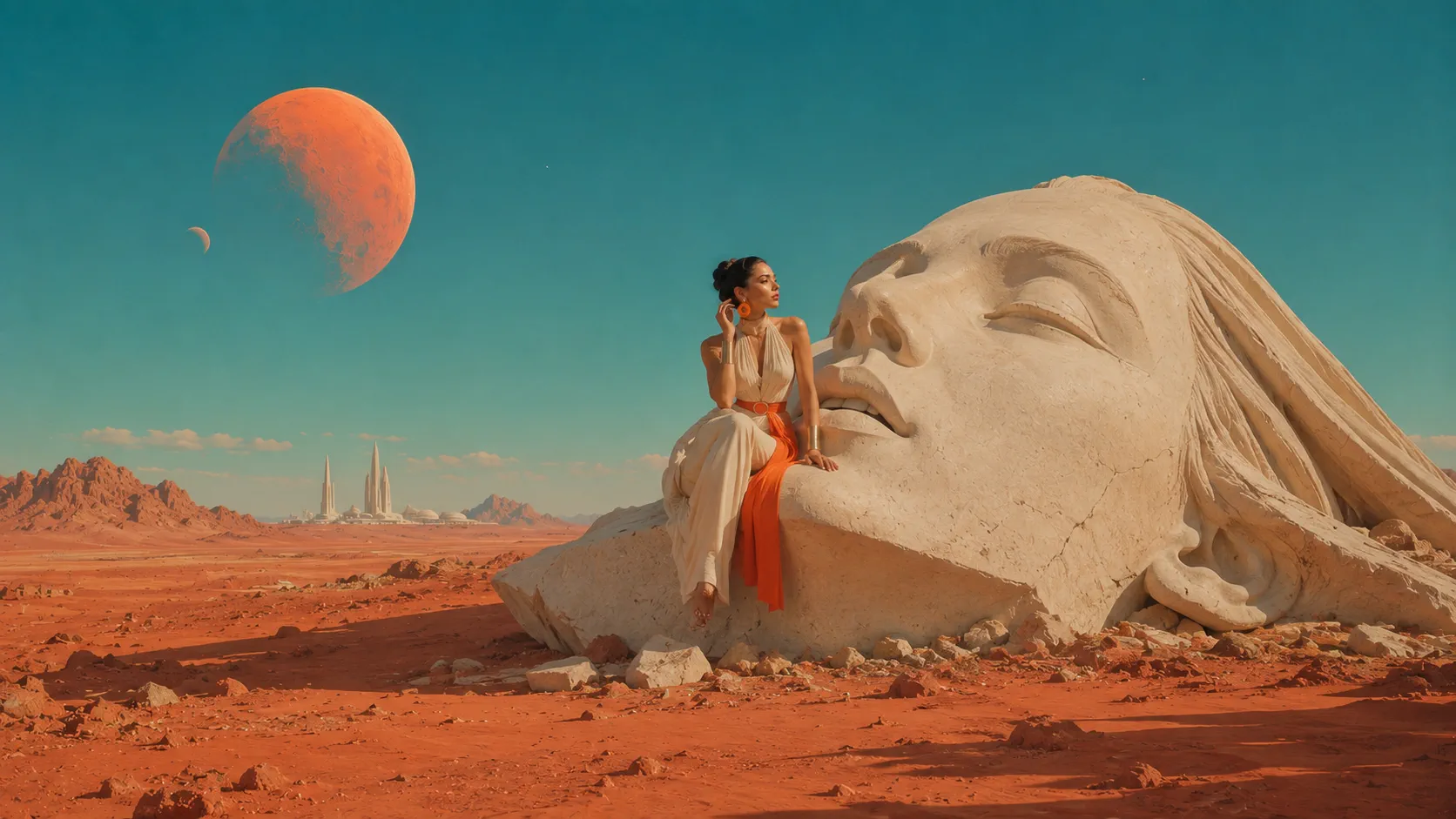
At Mars, We Do Not Want to Define What Looks Good
Of course we use AI.
We use it to generate product visuals.
Change the scene.
Create a model vision.
Create Editorial.
Development Campaign.
Create dynamic content.
Let the same piece of clothing enter different characters, different spaces and different worlds.
But these capabilities mean nothing if they end up making all brands look the same.
So we're more interested in defining a Mars Style and having everyone copy it.
We want Mars to be an amplifier.
Amplify what a brand already has.
Or help it discover things it isn't fully aware of yet.
Maybe a color.
A kind of distance.
A character's temperament.
A kind of light.
A strange space.
A visual mood that doesn’t belong to any of the current trends.
Technology should widen the differences between brands.
Instead of compressing everything into an average that is easiest for the algorithm to understand.
Taste Is Not a Prompt
Today, people are starting to take a very serious look at how to write prompts.
This is reasonable.
But Prompt is never the final ability.
Future models will increasingly understand human intentions.
The operation will become easier and simpler.
There will be fewer and fewer parameters.
The generation will get faster and faster.
Many things that today seem to require professional skills will eventually become infrastructure.
What really cannot be solved automatically is still judgment.
You must know:
Which one should stay.
Which one is too safe.
Which direction has been seen.
Which one is not like you enough.
Which, while strange, is worth continuing.
Machines can generate a thousand worlds.
But it cannot decide for a brand:
Which world deserves to be yours?
This is taste.
It's not a filter.
Not a prompt.
Not a set of swatches either.
It is the ability to continually make choices.
When Beauty Becomes Cheap
There will definitely be more beautiful pictures in the future.
More beautiful ads.
More beautiful models.
More pictures that are so beautiful that they have almost no technical flaws.
We are not pessimistic about this.
Quite the opposite.
When beauty becomes cheap, we can finally stop treating “beautiful” as an end point.
Then start talking about more interesting things.
attitude.
personality.
Strangeness.
culture.
humor.
desire.
conflict.
memory.
world view.
And what exactly a brand believes.
Perhaps the most precious picture in the future will not be the most perfect one.
But the moment you see it, you will know:
It couldn't have come from anywhere else.
— MARS JOURNAL