A new costume has just been completed.
It might still be hanging on a sample rack.
It may have just arrived from the factory to the office.
Probably not even officially in the studio yet.
But from this moment on, a whole set of unseen work is already waiting for it.
Product photography.
Model photo shoot.
Detailed shots.
Edit pictures.
Go to background.
Copywriting.
selling point.
Details page.
poster.
social media.
Different sizes for different platforms.
Different languages for different markets.
Then there's the video.
Then comes the next new thing.
One more thing.
For today’s brands, the truly difficult thing is rarely “owning a product.”
The hard part is:
How to get this product into the world.
Behind Every Product Is an Expanding Production Chain
In the past, content production had a very clear division of labor.
The photographer takes the photos.
The model is responsible for the presentation.
Retouchers process images.
Designers create pages.
The copywriting team organizes the language.
The marketing team adapts to the channel.
The video team starts over with another process.
In large-scale business systems, this division of labor was once very effective.
But today, brands face completely different content needs.
A product no longer only needs a product image.
It needs to appear on official websites, e-commerce platforms, Instagram, TikTok, Xiaohongshu, advertising systems, emails, short videos and countless new digital interfaces.
Each channel has its own dimensions, language, and visual conventions.
So, an originally very simple question:
"We just made a new dress."
Start spawning dozens or even hundreds of follow-up tasks.
What really slows down a brand is often not creativity.
It’s the long execution that follows the idea.
We Rethought the First Step
Most creative software starts with a blank page.
They ask you:
What do you want to do?
Choose a mode.
Upload material.
Choose a scale.
Choose a style.
Enter Prompt.
Modify parameters.
generate.
Not satisfied.
Readjust.
Generate again.
Then take the results to another software and move on to the next thing.
Each tool may itself be improving efficiency.
But when they are connected together, people still need to be responsible for the entire process.
In our opinion, this is not enough.
A truly efficient system should not just make every step in the process faster.
It should make a lot of steps disappear right away.
So the first step of Mars is not Prompt.
Not a template.
It's not even "create project".
Instead:
Take a photo of this dress.
That's all.
Capture.
Open Mars.
Pick up your phone.
Photograph clothing.
This could be a sample garment from the studio.
A new item just arrived.
A hanging dress.
A top that sits on the table.
Real-life clothing is the only thing that really needs to be input into the entire process.
Because Mars doesn’t start with a literal description of a product.
It starts with the product itself.
It looks at the color, silhouette, structure, proportion, material and design features of clothing.
Understand what it is.
Then, the rest of the work begins to happen.
Create.
This is where Mars really differs from traditional AI creation tools.
The user does not need to decide further:
The next step is to make a white background picture or a model picture?
Which model should you choose?
Write the copy first or create the details page first?
What size should I use for product posters?
Which picture should the video start with?
This shouldn't be the user's job in the first place.
Mars understands a piece of clothing as a complete content production task, rather than a separate image generation request.
So after the shooting is completed, the system begins to build the digital assets it needs around the item.
Enter once.
Then, expand outward.
The Product Asset System Begins to Take Shape
The most basic layer is to make the product itself usable.
Clothing is transformed into clean, clear merchandise vision.
White background illustration.
Standardized product display.
Different angles.
Basic materials suitable for e-commerce environments.
Areas of detail are further identified and presented.
Neckline.
cuffs.
Waistband.
placket.
fabric.
Crop.
The places where consumers will actually pay attention before buying no longer require a reorganized set of shooting assignments to appear.
This layer solves the most basic and most repetitive content needs in the business world:
Get the product into a salable state quickly.
Then, It Is Worn
Products should not stay on a white background forever.
Consumers need to understand what happens when a piece of clothing is put on a real body.
So the same product continues to enter the model's vision.
Different characters.
Different postures.
Different compositions.
different environments.
A piece of clothing can have a complete wearing context, and brands don’t need to reschedule a shoot for every change.
What's more, these contents don't exist in isolation.
They still come from the same item that was originally photographed.
Clothing is always central.
Then, It Finds Its Sales Language
After the product map was established, another process that had been separated for a long time began to occur at the same time:
language.
Mars can continue to generate marketing content around product understanding.
Product description.
Core selling point.
Visual main title.
subtitle.
Marketing expressions required by different channels.
When the same product enters different platforms, it can also use language that matches different content environments.
This means that product information no longer needs to be manually re-translated into marketing content again and again.
What the graphics team saw was a piece of clothing.
The copywriting team saw the same dress.
In Mars, for the first time, they actually share the same starting point.
Then, It Becomes a Complete Product Page
Consumers rarely understand a product through an isolated image.
What they see is continuous information.
Overall.
Details.
Wear effect.
Material.
Design language.
selling point.
brand.
Therefore, the images and text built around the product can continue to be combined into more complete e-commerce visual assets.
Detailed visual.
Selling point expression.
Product display module.
Brand main image.
Disseminate material.
Information that used to need to be collected from multiple teams, retyped, and reorganized began to form naturally in the same production chain.
Commodities are not produced first as "materials" and then wait for another person to turn the materials into content.
It starts directly as content.
Then, we leave the product page
At this point, Mars has been able to complete a large amount of daily commercial production.
But if it stops here, it's still just a more efficient production system.
What we're really interested in happens next.
When all the work that needs to be done has been done quickly:
What can you do with the remaining time?
Maybe we can start creating images that don’t “have to be there.”
Pictures that wouldn’t appear on a traditional shot list.
Those things that no one asks for but may really make a brand be remembered.
So the merchandise started leaving the studio.
Enter the building.
Enter the night.
Enter the pool.
Enter the desert.
Entering a hotel that doesn't exist.
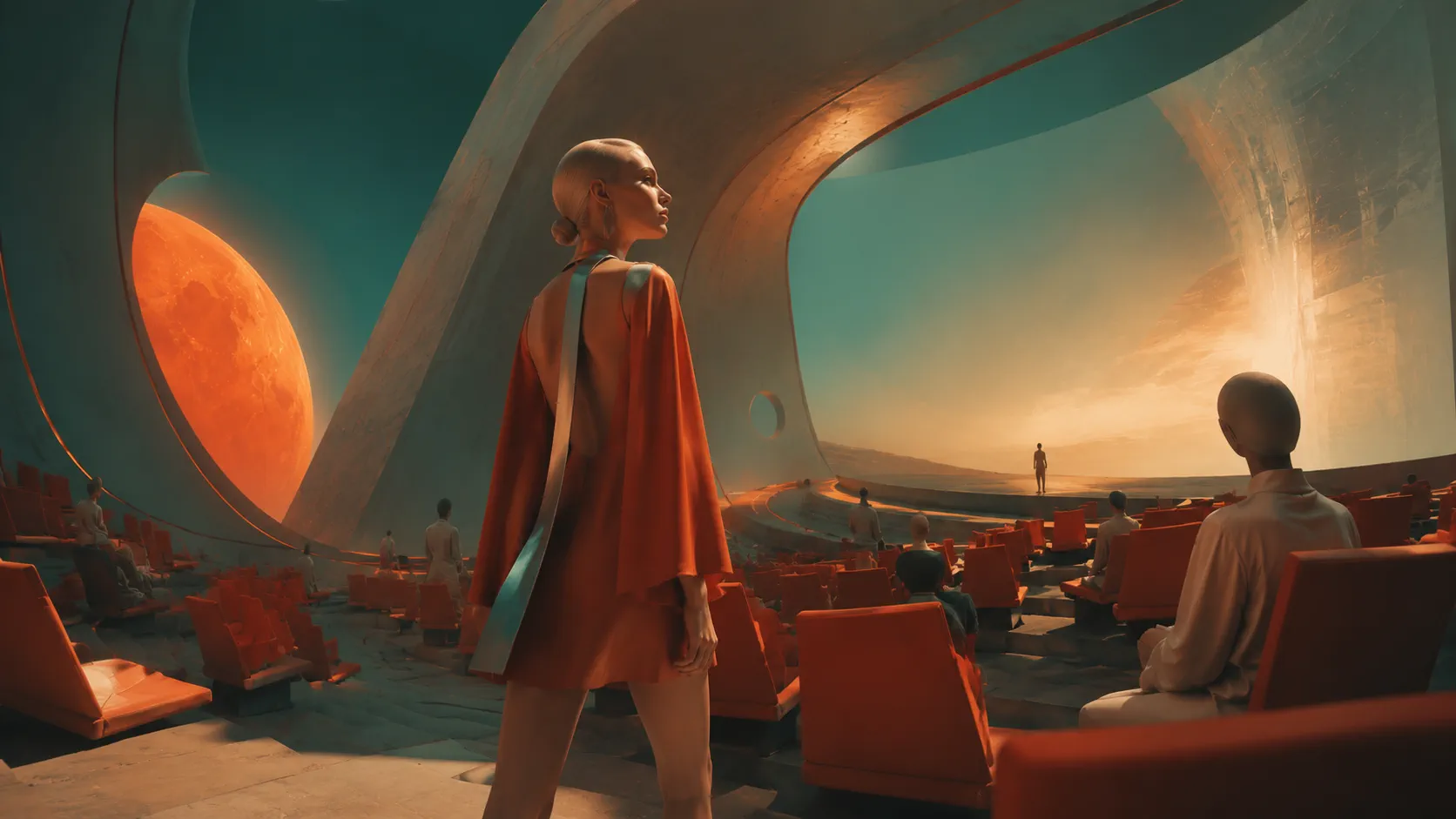
Enter another planet.
From Asset Creation to World Building
Mars does not just build product assets.
It continues to build the world of brands.
Editorial。
Campaign。
Brand poster.
Social vision.
Concept image.
The same piece of clothing can grow from a basic product image to a complete brand expression.
Reality has not gone away.
That actual piece of clothing is still where it all started.
It’s just that it’s no longer limited by reality.
We believe both should exist simultaneously.
A brand needs to be accurate.
It also requires imagination.
Conversion required.
Desire is also required.
Consumers need to be told:
This is what we sell.
It also needs to make consumers feel:
This is the world I want to enter.
Finally, the World Begins to Move
Dynamic content shouldn’t be started from scratch once merchandise, characters, scenes, and visual language have been established.
They can go on to become videos.
The model begins to move.
The camera starts to move.
Scene gets time.
Static Campaign started to become Motion.
Product photography, brand vision and video production, which were originally separate from each other, began to become different states in the same continuous system.
From the time a piece of clothing is photographed to the time it finally hits the consumer's screen, there's no need to start over again.
No Prompt Is a Design Decision
Today, AI products often regard “having more control” as a capability.
More models.
More parameters.
More sliders.
More choices.
We do not believe that complexity equals expertise.
If a system already understands well enough what the user wants to do, then it should take on more decisions rather than handing the problems back to the human that the machine needs to understand.
What clothing brands really want to do is never:
"Adjust guidance scale."
Nor:
“Learn how to write a better prompt.”
They want to launch new products.
Build product assets.
Complete the campaign.
Enter the market.
Mars' work should happen behind the scenes.
Complexity can exist.
But it doesn't have to be in front of the user.
The intelligence should be inside the system, not inside the workflow.
Intelligence should reside within the system, not become the process itself.
Time Should Be Spent Deciding, Not Executing
Efficiency doesn't mean everything needs to be faster.
Some things are worth slowing down.
Which campaign to choose.
Decide what kind of visual world a brand should have.
Determine which model truly represents the brand.
Discuss whether a color should be more intense or more restrained.
These decisions are worth time.
But it’s not worth remaking a product image into another size.
It’s not worth filling in product information repeatedly.
It's not worth re-uploading the same piece of clothing in another system in order to generate the next material.
The goal is not to get people to do boring tasks faster.
Instead, try to prevent these jobs from appearing at all.
One Photograph. Everything After.
Imagine a small clothing brand has just received new products to be released tomorrow.
They do not need to establish a production plan first.
There is no need to coordinate a content pipeline.
There’s no need to open six different software, either.
They took out their cell phones.
Photograph it.
Mars began to continue.
The product vision is established.
The model appears.
Details are seen.
Selling points are written down.
Details are formed.
The brand vision begins to unfold.
Campaign appears.
The screen starts to move.
A piece of clothing that just existed in the real world began to take on a complete digital life.
This is what we understand as efficiency.
Instead of accelerating each of the ten steps by 30%.
Instead, reframe the problem so that most of the steps disappear.
Because the best technology always has a similar feel in the end.
You're not constantly aware that it's working.
You will only find:
It turns out that this matter has been completed.
Take the photograph.
We take care of everything after.
— MARS JOURNAL