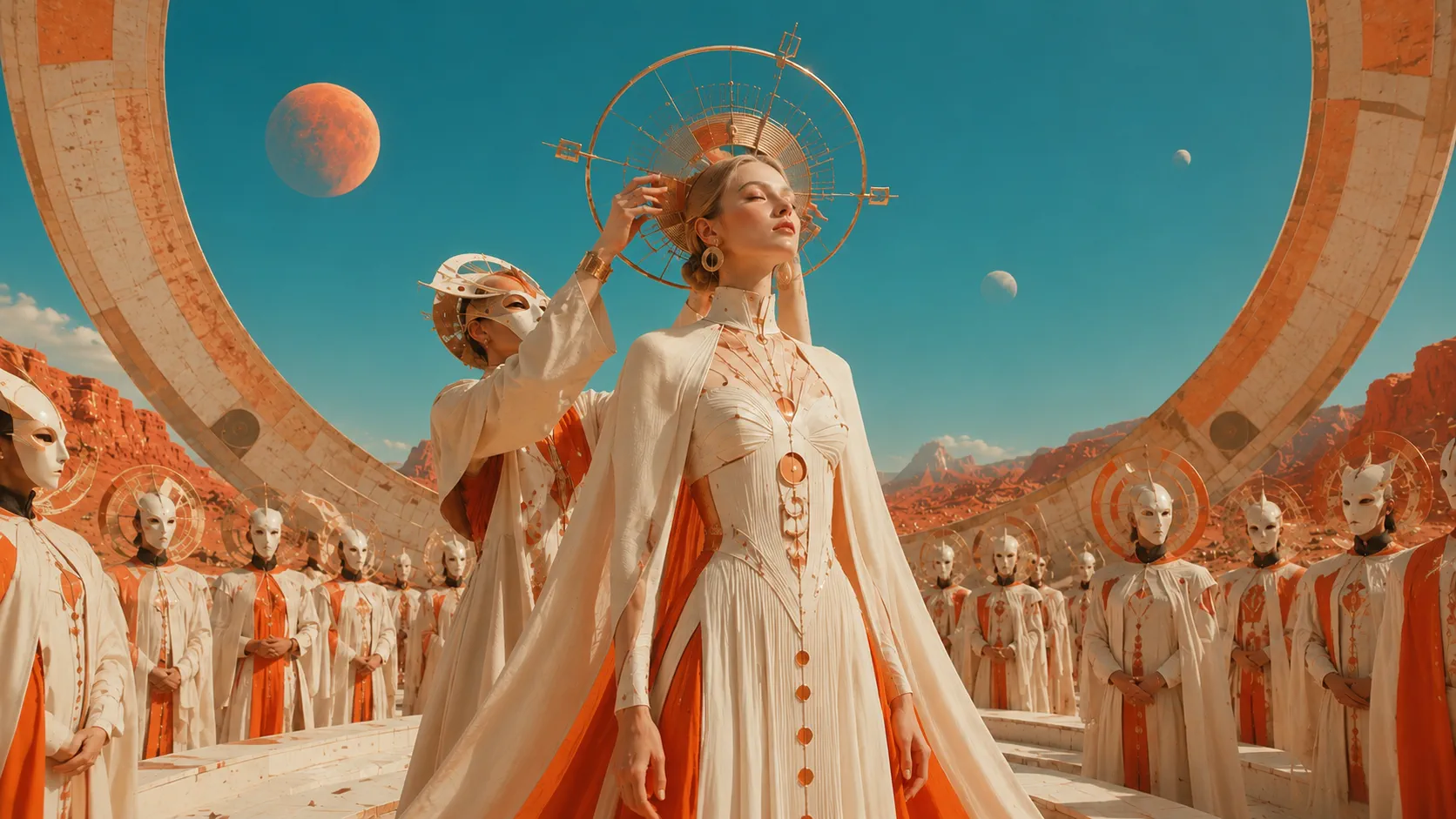
There was a time when the future meant leaving.
Leaving the city.
Leaving the atmosphere.
Leaving the familiar geometry of streets, rooms, windows and skies.
We imagined silver aircraft suspended above oceans, cities beneath glass domes, clothes made for climates that did not yet exist. We looked upward because the future seemed to live somewhere beyond the horizon.
Then, somehow, we stopped.
The future became smaller.
It moved into our pockets, onto our screens, into faster deliveries and thinner devices. Technology advanced, but imagination became strangely practical.
We learned how to make everything more efficient.
We forgot how to make it feel impossible.
Maybe that is why Mars still matters.
Not Mars as a destination.
Mars as an idea.
A place far enough away from reality that the rules begin to loosen.
The Unknown Has Always Dressed Differently
Fashion has never belonged entirely to the present.
A shoulder becomes wider than anatomy requires.
A dress follows a silhouette that does not exist in nature.
Metal, silk, plastic and light are arranged around the body until a person begins to resemble someone from another century — or another planet.
Clothing has always allowed us to leave before our bodies do.
We dress for lives we have not lived yet.
For cities we have never visited.
For versions of ourselves that exist only briefly in mirrors.
Perhaps this is why fashion and science fiction have always felt strangely close.
Both begin with the same question:
What if the world were different?
Not better.
Not more efficient.
Just different.
A different gravity.
A different sun.
A different body.
A different way of being seen.
Earth Became Too Familiar
There is nothing wrong with reality.
But reality has become very well documented.
We have photographed almost everything.
The perfect white studio.
The concrete wall.
The hotel corridor.
The empty beach.
The brutalist building.
The café table at 4:17 in the afternoon.
Millions of images arrive every day, technically beautiful and somehow already familiar.
We know the lighting.
We know the lens.
We know where the model will stand.
Sometimes an image fails not because it is badly made, but because we already know what it is going to say.
The problem is not that we need more images.
We need places we have not seen before.
So We Invent Them
A swimming pool hangs upside down above a ballroom.
A woman waits beneath two suns.
A highway disappears into a red horizon while nobody remembers where it was built.
Mirrored faces gather silently at a dinner table.
A dress moves through a room that could have existed in 1972, 2072, or nowhere at all.
None of these places need to be real.
That is precisely the point.
For most of visual history, imagination had to negotiate with physics.
A location had to exist.
A set had to be built.
Light had to reach a surface.
A camera had to stand somewhere in front of it.
Now the distance between an imagined world and a visible one is collapsing.
And that changes something larger than production.
It changes what we are allowed to imagine in the first place.
The Future Is Becoming Strange Again
Maybe the most interesting thing about artificial intelligence is not that it can reproduce reality.
Reality was never in short supply.
The interesting part begins when we stop asking it to imitate what already exists.
When we use it to remember futures that never happened.
To construct architectures without architects.
To photograph weather that has no name.
To place familiar objects inside unfamiliar worlds and see whether they become unfamiliar too.
This is where technology becomes cultural rather than technical.
Not when it works perfectly.
When it gives imagination somewhere new to go.
The future does not need another polished version of the present.
It needs mystery.
It needs bad maps.
It needs rooms with no obvious entrance.
It needs skies in colors we cannot quite name.
It needs things that make us look twice.
We Were Never Meant to Stay on Earth
Perhaps we will stay here forever.
Perhaps most of us will never see another planet.
That was never really the point.
Leaving Earth has always been as much an act of imagination as an act of engineering.
Long before we could travel beyond the atmosphere, we had already been there in novels, paintings, films, clothes, photographs and dreams.
Humans leave reality constantly.
That is one of the things we are best at.
We invent somewhere else.
Then we bring something back.
A shape.
A color.
A material.
A photograph.
A feeling.
A new way of looking at something that was ordinary yesterday.
Mars is not necessarily where we are going.
Sometimes Mars is simply the name we give to the distance between the world as it is and the world as it could be.
And perhaps that distance is where everything interesting begins.
— MARS JOURNAL