For most of human history, creating something beautiful often meant a lot of invisible labor behind it.
Before there were photos, there were photo shoot announcements.
Before Campaign, it was table after table.
Before an image finally appears on the screen, someone has to book a studio, identify models, coordinate samples, check sizes, adjust schedules, move lights, rename files, export different versions, resize, write copy, change copy, send links, wait for feedback—and then do it all again.
We rarely see these.
All we see is the final image.
The finished work has a strange ability to make the labor that created it disappear.
Perhaps this is one of the reasons why beauty seems so effortless.
But "looking effortless" and "really requiring a lot of meaningless effort" are not the same thing.
For a long time, the creative industry confused these two things.
Creativity Is Never Found in Repetition
It’s easy to romanticize difficult and complex creative processes, as if the more difficult the process, the more meaningful the final creation.
Sometimes, it is.
A painter who spends several months facing a single canvas is not wasting his time.
A designer who cuts patterns by hand may discover something in the process that no shortcut can bring.
A photographer waiting for the right light is by no means performing some outdated ritual.
Some resistance will make an idea sharper.
But there is still some resistance and nothing will come of it.
Modifying the same picture into fifteen sizes is not creation.
Moving information from one system to another is not creation.
Recreating an almost identical layout for another market is not creation either.
Because no one has ever redesigned the process, today we are still mechanically repeating yesterday's work methods - this is not the so-called "craftsman spirit".
It just repeats.
This distinction is very important.
Because when we protect every link in the process on the grounds of "respecting creation", what is ultimately protected may no longer be the creation itself.
It's just the huge bureaucracy that surrounds creation.
The Best Tools Make Something Disappear
We often describe technology in terms of "what it adds."
Faster.
Stronger.
Higher resolution.
More possibilities.
But some of the really important technologies in history were important precisely because they made something disappear.
Elevators make climbing disappear.
The camera eliminates the need to describe every detail in front of you.
Desktop publishing eliminates a complex physical typesetting process.
Digital editing eliminates scissors, tape, duplicate footage, and a host of irrevocable decisions.
These technologies were never intended to eliminate humans.
They just move people's intentions to another place.
So the really interesting question is never:
What can technology do for us?
Instead:
What other things are not worthy of human beings to continue to spend their lives on?
This is a completely different question.
Perhaps, it is also a question worth asking.
Attention Should Be Spent on Better Things
Attention is limited.
Every hour spent doing repetitive tasks is one less hour spent imagining something else.
In the creative industries, this is especially ridiculous.
Companies often recruit people precisely because of their aesthetics, intuition, sensitivity and ideas.
Then, these people are left to spend a lot of time doing jobs that hardly require any of these abilities.
Creative directors become coordinators.
Designers become image exporters.
Photographers become asset producers.
A brand team spends more time constantly "feeding the content machine" than thinking about "how this brand should make people feel."
Eventually, the entire process grew so large that sustaining production itself began to eat away at the very imagination that production was supposed to serve.
What we want should be exactly the opposite.
A little less maintenance.
Be more curious.
Less repetitive.
Experiment a little more.
Spend less time making the hundredth version that we already understand.
Take the time to create the first version that no one has ever seen before.
AI Should Do the Boring Parts
This is where artificial intelligence really starts to get interesting.
Not because it produces a picture.
This thing is quickly becoming commonplace.
Its deeper possibilities lie in:
It can finally begin to take over the large-scale, repetitive and tedious production labor that has long been regarded as "inevitable" by the creative industry.
A piece of clothing should not have to go through a whole set of repetitive production links just to appear in different scenes.
A campaign should not mean re-shooting, re-finding venues, re-coordinating logistics, and adding another week of communication just because you try one more idea.
A small brand should not have fewer visual possibilities just because the team is smaller.
From an idea to the time it is actually seen, the machine is already too heavy.
And AI gives us an opportunity to redesign this machine.
At Mars, we're using it to compress workflows that used to consist of a lot of disconnected parts.
A piece of clothing can continue to become product vision, model vision, campaign, editorial world, language content and dynamic images without the need to re-establish the entire production system every time.
The purpose is not to produce more for the sake of “producing more.”
The real purpose is to shorten the long, boring and unnecessary distance between an idea and its actual realization.
Efficiency Matters Only When It Creates New Possibilities
There’s a future for AI that actually sounds pretty boring.
Everything becomes faster.
Everything becomes cheaper.
Everyone produces more.
More Banners.
More posts.
More versions.
More content continues to fill more screens.
If that's all we end up doing, then we've just created an amazing technology used to produce mediocrity faster.
Efficiency itself is not a vision.
The real opportunity comes after efficiency.
When a production barrier disappears, will things that could not happen in the past because they were "unrealistic" begin to become possible?
Can a small brand build a visual world as complete and grand as a global fashion house?
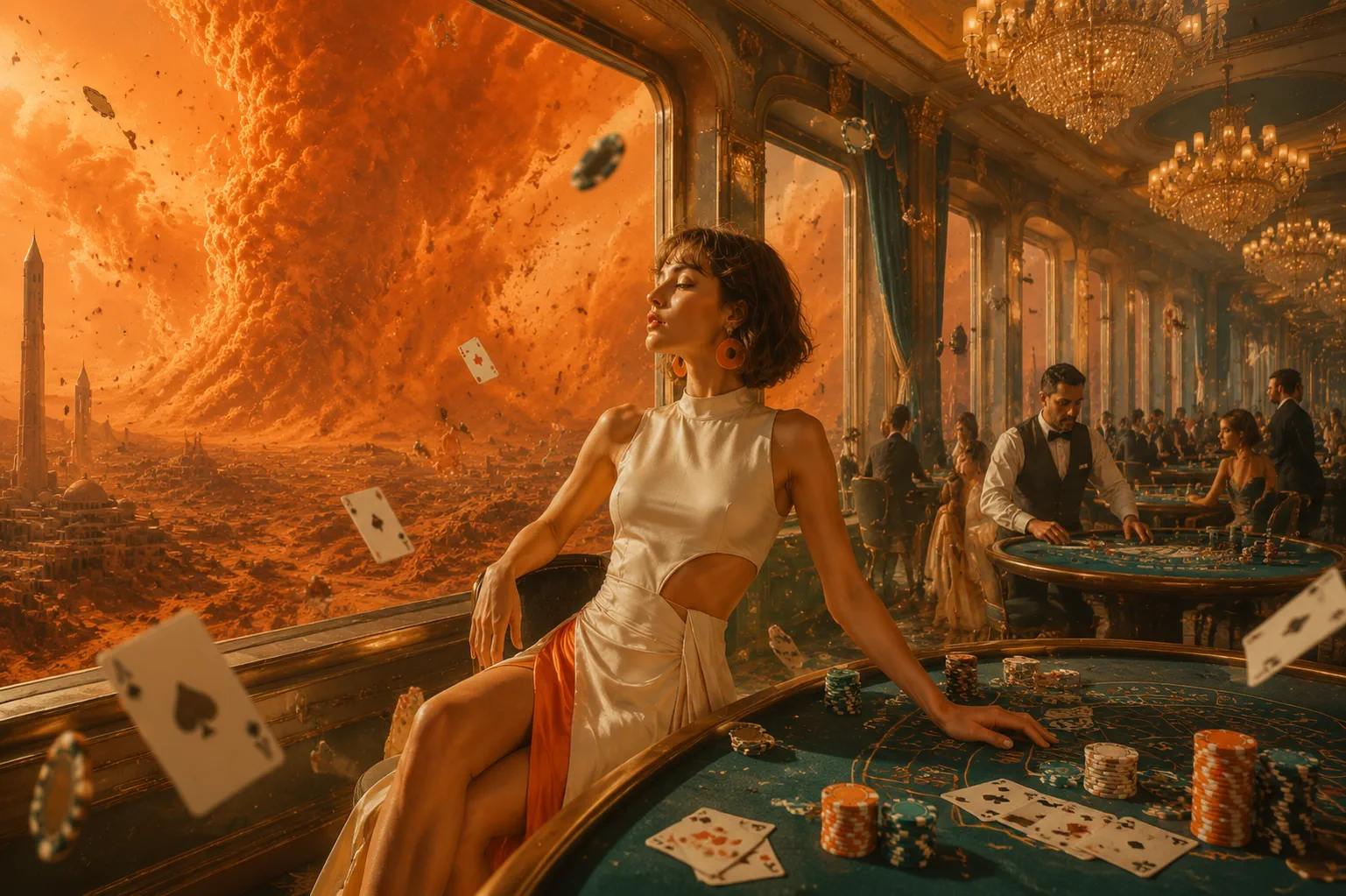
Can a piece of clothing appear under an alien sun, in a forgotten hotel, beside a suspended swimming pool, and on an empty road leading to the end of an imaginary planet before lunch?
Can a creative team try ten ideas at the same time, instead of having to prove that one is the best because they can only afford one?
Can we still recreate something weird?
This is the future that interests us.
It’s not a world where “machines do everything for humans”.
Rather, it is a world where machines begin to take on jobs that are not worthy of occupying so much human attention in the first place.
Then, one regains something.
time.
attention.
Curiosity.
The freedom to let go of an idea.
The freedom to try another one.
The freedom to create something that’s unnecessary, doesn’t make sense, but is too beautiful to ignore.
And, the freedom to create something truly new.
More Imagination in Every Hour
Perhaps we’ve been measuring productivity the wrong way all along.
Over the past 100 years, we have asked:
How much can be produced in an hour?
But perhaps, the more interesting question of the next century should be:
How much imagination can be accommodated in one hour?
Technology should not just give us more output.
It should give us space.
Room to roam.
Room to fail.
Space to create worlds where there is no commercial reason to exist yet.
Keep following a picture just because it makes us feel a strange space.
Those tedious labors should quietly disappear into the machine.
And the part that belongs to people should become bigger.
Not smaller.
Because our end point is never automation.
Our end point is possibility.
— MARS JOURNAL