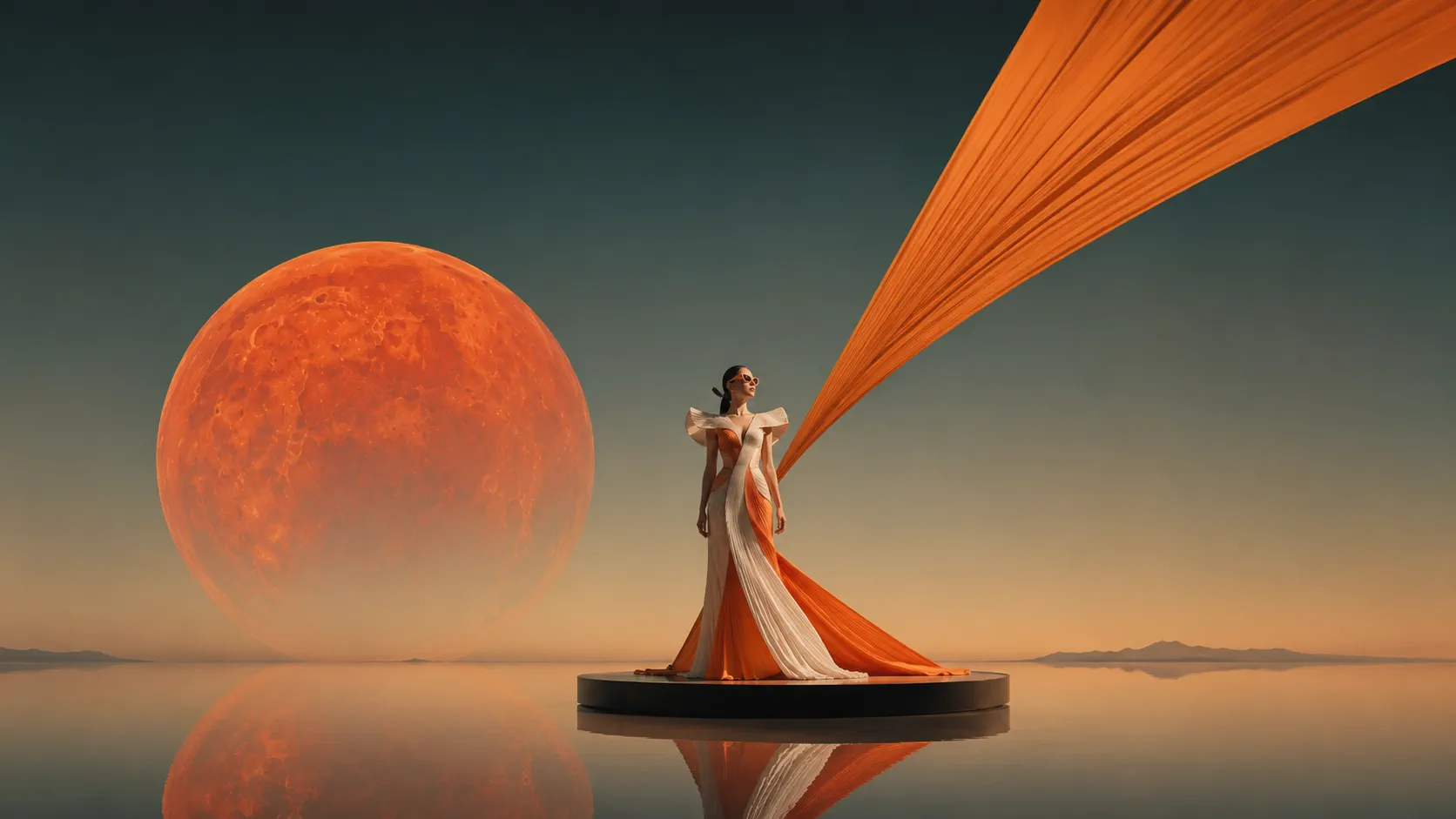
When a piece of clothing is designed, it is not yet finished.
It has color, material, structure and outline.
But it doesn't have the environment yet.
There are no characters.
There is no story.
There is no sound.
There is no world for it.
What really makes a piece of clothing enter the consumer's field of vision is often not the clothing itself, but everything that is later built around it.
The photographer decides the light.
The model gives it body.
Scenes build mood.
Designers build layouts.
Copywriting gives language.
The video gets it moving.
Eventually, people saw more than just a piece of clothing.
Rather, it is a whole world about how it should be understood, imagined, and desired.
This is why fashion is never just about making products.
It keeps making worlds.
Building a World Used to Be Too Expensive
In the past, if a brand wanted a new product to actually enter the market, it needed to establish a long content production chain.
Products need to be photographed.
Models require reservations.
The studio needs coordination.
Scenes need to be found.
Pictures need to be post-processed.
The details page needs to be designed.
Selling points need to be reorganized.
Different platforms require different versions.
Video means another set of shooting, editing and production processes.
And when the number of new products increases from one to dozens or hundreds, the system will expand rapidly.
So, a very strange phenomenon occurred:
Brands have more and more channels, but less and less time to really think about creativity.
We originally had more places to express ourselves, but we spent more and more energy on "how to produce content."
As a result, the parts that truly determine brand differentiation—ideas, aesthetics, and worldview—are constantly compressed by the production process.
This is what Mars wants to change.
Not giving brands another AI tool.
Instead, rethink:
What if a piece of clothing itself can become the starting point of the entire content production system?
It Begins with One Photograph
Mars workflows are intentionally designed to be simple.
Take photos of the outfits with your phone.
Then, let the system continue.
No complicated prompts.
There is no sequence of model parameters.
There is no need to decide what picture should be generated first, and then decide what to do with the next picture.
Because what most brands really need is not “an AI picture.”
What they need is a whole set of content that revolves around one product.
Mars starts from the product itself, understands its style, color, structure, material and visual characteristics, and allows this information to continue to enter the subsequent content production process.
From this moment on, a piece of real clothing begins to have its digital world.
01 — Product
First, it should be clearly visible.
Mars can build a complete product vision around clothing, including white background product images, different display angles, clothing details, and basic product assets suitable for use in e-commerce environments.
This section does not attempt to "redesign" the product.
Quite the opposite.
Its mission is to preserve as faithfully as possible the original structure, proportions, fabrics, colors and design details of the garment.
Because the starting point of all imagination should first be based on respect for the product itself.
At the most basic level, Mars solves a very real problem:
Let a product that has just been photographed quickly become a digital asset that can actually be put into use.
02 — Model
Then the clothes get the body.
The same piece of clothing can enter different characters, different postures and different visual contexts.
This means brands no longer have to reorganize a complete model shoot for every expression.
An item can be a clean, restrained studio shot.
You can also go into the city.
Appearing in a vacation scene.
Enter the night.
Enter the building.
Even enter a space that does not exist in reality.
What really changes here is not just production efficiency.
But for the first time, the brand can extensively explore "what kind of person, what kind of environment and what kind of emotion this dress should belong to" before formal production.
In the past, costs forced brands to make decisions sooner rather than later.
Now, brands can see more possibilities before deciding what is their true direction.
03 — Detail
Fashion doesn't just happen with full silhouettes.
Many times, it’s the very small things that really make people want to buy a piece of clothing.
A neckline.
One cut.
A waistline.
A button.
The texture of a fabric under light.
Mars can continue to generate visual content suitable for product display around these details, allowing design information originally hidden in an ordinary product photo to be seen more clearly.
Because the significance of product vision is never just to prove:
"This dress exists."
It also requires explanation:
Why it deserves a closer look.
04 — Language
Then vision begins to have language.
An item needs a name.
Description is needed.
A selling point is needed.
Different platforms need to be able to understand its expression.
The same product should not always say the same thing on the brand's official website, product detail pages, social media and different e-commerce platforms.
Mars can start with the product itself and continue to build the marketing language around it.
From product information to selling point expression.
From brand copywriting to content versions required by different channels.
Imagery and language are no longer two separate workflows.
They come from the same product and should share the same underlying understanding.
05 — Editorial
At this point, a piece of clothing is ready for sale.
But we believe this is not enough.
Because the real difference between the brand and the product catalog starts here.
Mars allows the same piece of clothing to leave the boundaries of traditional e-commerce photography and enter a more complete Editorial visual world.
Space can be reimagined.
Buildings don’t have to exist.
The light can come from another sun.
Physical conditions in reality no longer determine where a picture can occur.
This is not about creating a spectacle.
But because brands need some pictures, they are not responsible for explaining the products.
They are responsible for making people remember a feeling.
Product picture answer:
"What is this?"
Editorial replied:
"What kind of world does it belong to?"
Both are equally important.
06 — Campaign
Once a visual language is established, it can continue to develop into a campaign.
Main vision.
Brand poster.
New product release visual.
Social communication materials.
Extension in different formats and communication environments.
In the past, a campaign often meant a new production project.
We want it to become the next layer that grows naturally from the product world.
In this way, product vision, model vision and brand vision are no longer isolated projects.
They begin to belong to the same world.
This is especially important for brands.
Because a truly high-end brand sense does not mean that a certain picture is particularly beautiful.
But when a person sees ten, fifty, or even a hundred pictures in a row, he can still feel:
They come from the same place.
07 — Motion
Finally, the world begins to move.
Static visuals can continue to become dynamic content.
The model begins to move.
The fabric begins to change with the body.
The camera begins to move through space.
A campaign that originally existed only on a flat surface can continue to become short films, merchandise videos, and social media motion content.
We don't believe video should be another entirely separate workflow.
If still images have established characters, costumes, space, colors, and a worldview, then moving images should continue to grow from there.
Rather than starting from scratch.
This Is Not About Generating More Images
If we understand Mars as a machine that can quickly produce a large number of images, then we actually miss the most important part.
The amount of content itself is meaningless.
The Internet has no shortage of pictures.
Brands don’t need to endlessly pile up more visual assets.
What really matters is:
How many ways can a product be understood?
It can be demonstrated accurately.
Can be worn by one person.
can be interpreted.
can be amplified.
Can be written into language.
Can enter a Campaign.
It can become an image.
Or enter a world that has never existed before.
In the past, these things were owned by different people, different software, different budgets, different shoots, and different schedules.
What Mars wants to do is reconnect them.
Let a product be the starting point.
rather than the end.
The Product Is Only the Beginning
We don’t believe that brands of the future will just need to “produce faster.”
That's too simple.
We're more interested in what happens when the production itself isn't so heavy.
Maybe a small team with only a few people can have an extremely complete visual expression.
Perhaps a newly completed design can be put into dozens of different worlds for observation on the same day.
Maybe the creative team could try ideas that don't seem to make sense first, without having to first calculate how much of the budget a failure would waste.
Maybe brands could spend more time thinking about:
Who are we?
What do we want to create?
What kind of world do we want others to enter?
The real thing to look forward to about technology is not that it helps us repeat the past.
Rather it lowers the cost of imagining a new thing.
A piece of clothing was photographed.
Then it starts to change.
Become an image.
Become a character.
become language.
Become a Campaign.
Become a movie.
Become the world.
The product is only the beginning.
— MARS JOURNAL